
WESPI in 2026 Setting the Standard for ESP Support Across 400 Units

Updated: Sep 9
Four hundred ESP units do not run well by accident. At that scale, every decision matters, from how a pump is selected and installed to how quickly a specialist can diagnose a fault in the field.
As of 2026, WESPI has managed a rollout that has grown to a maximum of 400 electrical submersible pump units across various fields. That number reflects more than capacity. It points to a support model built around industry knowledge, trained teams, modern facilities, and the discipline needed to keep field operations moving.
ESP systems operate in harsh conditions. They face heat, pressure, abrasive fluids, changing well behaviour, and tight production targets. When support falls short, the effect can be felt quickly through lost output, extended downtime, and higher repair costs.
WESPI’s work across 400 units shows what strong ESP support looks like when it is planned as a complete service, not treated as a response after something goes wrong.

Scale changes the standard for ESP support
Supporting a small number of ESP units is already technical work. Supporting up to 400 units across different fields requires a different level of control.
Each field can bring different operating conditions. Wells may vary by depth, temperature, fluid composition, gas content, sand production, and power quality. A support team must understand those differences before recommending an action. A solution that works in one site may not suit another.
That is why scale is not only a matter of numbers. It is a test of consistency.
When ESP support reaches hundreds of units, the operation must cover several connected areas:
unit selection and configuration
installation and commissioning
field troubleshooting
repair evaluation
performance tracking
spare parts readiness
root cause analysis
communication between field crews, engineers, and facilities
The stronger the connection between these areas, the better the outcome. A field technician’s observation is more useful when engineers can compare it with operating history. A repair report carries more value when it feeds back into future installations. A spare part is more than stock when it prevents a long production delay.
For WESPI, the 2026 rollout reflects this broader view. ESP support is not handled as separate tasks. It is managed as an operating system for reliability.
What supporting 400 ESP units really involves
An ESP unit is a complex downhole system. It commonly includes a pump, motor, protector, intake, cable, surface control equipment, and related accessories. Each part must work with the others. If one component fails, the entire system can be affected.
At 400 units, support must be both wide and precise.
A wide support system makes sure teams can respond across several fields. A precise support system makes sure each well receives the right attention based on actual operating conditions. WESPI’s approach depends on balancing both.
Support area | Why it matters at 400 units |
Field service readiness | Crews must travel, inspect, install, and troubleshoot without unnecessary delay. |
Engineering review | Pump performance must match well behaviour, not just standard specifications. |
Repair and testing | Failed or retrieved equipment needs proper inspection before being returned to service. |
Inventory planning | Critical parts should be available before urgent demand appears. |
Data and history | Past performance helps teams make better decisions for current wells. |
Safety discipline | Larger operations need clear procedures to protect people and equipment. |
This type of support also requires clear handovers. When an ESP is pulled from a well, the information gathered during retrieval can shape the repair process. When a repaired unit returns to service, the installation team needs to understand what changed. When a unit shows signs of stress during operation, the field team needs a way to escalate the issue before it becomes a failure.
The work is practical, but it depends on discipline. A missed reading, unclear record, or delayed report can make a technical problem harder to solve.
That is why high-quality ESP support often looks simple from the outside. The visible work may be a site visit, a test, or a replacement. Behind that work sits planning, documentation, skilled judgement, and the ability to act before a small issue becomes a major stoppage.

Specialist teams turn experience into faster decisions
ESP failures are rarely solved by guesswork. The same surface symptom can have more than one cause. A rise in motor temperature, for example, may relate to loading conditions, cooling, electrical supply, well fluid changes, or a mismatch between equipment and the well.
Specialist teams help narrow the problem faster.
WESPI’s strength comes from combining field experience with technical review. Field crews understand site conditions. Engineers understand equipment behaviour and system design. Facility teams understand inspection, testing, and repair processes. When these groups work closely, decisions improve.
A strong specialist team can ask better questions:
Has the well behaviour changed since installation?
Is the pump operating within the expected range?
Are electrical readings stable?
Do vibration or temperature trends suggest early stress?
Was there a history of sand, gas locking, scale, or power interruption?
Did the retrieved equipment show wear patterns that match the operating data?
These questions matter because good support is not only about restoring service. It is about learning why the issue happened and reducing the chance of repeat problems.
Across a 400-unit rollout, this learning compounds. Each field event adds to the team’s knowledge. Each repair finding can guide future installations. Each well history can make diagnosis faster the next time a similar condition appears.
That is how experience becomes a service advantage. It moves from individual judgement into a shared support culture.
Modern facilities make field work more reliable
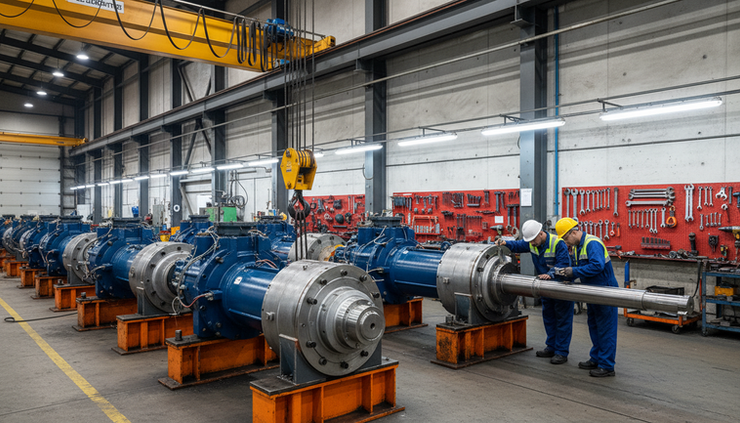
Field performance often depends on what happens away from the field. Workshops, test areas, storage systems, and preparation zones all affect how well ESP operations run.
Modern facilities give support teams the space and tools to inspect equipment properly, prepare assemblies, maintain quality control, and reduce unnecessary delays. They also help separate urgent work from planned work, which is essential when supporting many units at once.
For ESP support, facilities may contribute in several ways.
Inspection and verification
Components need careful checks before installation or reuse. Visual inspection, measurement, electrical checks, and review of physical wear can reveal issues that are not obvious during field handling.
Repair assessment
When equipment is retrieved, the facility team can examine the condition and help identify possible causes of failure. That assessment gives engineers better information for future recommendations.
Preparation before mobilisation
A well-prepared unit saves time in the field. Proper packing, labelling, checking, and documentation reduce the risk of missing parts or unclear instructions at site.
Controlled handling
ESP equipment can be sensitive to poor handling. Facilities designed for the work help protect components before they are deployed.
At a smaller scale, teams may be able to compensate for weak systems through individual effort. At 400 units, that approach does not hold. Facilities, processes, and people must support one another.
WESPI’s modern facilities are part of the reason the company can maintain service quality as the number of ESP units grows. They give the field teams stronger backing and create a more reliable path from inspection to deployment.
Support quality shows up in the small details
Professional expectations in ESP support are high for good reason. Operators need fast response, accurate diagnosis, safe execution, and dependable communication. A support provider cannot rely on technical skill alone. The service experience must also be consistent.
Small details often decide whether support feels reliable.
A crew that arrives with the right tools prevents wasted trips. A report that clearly explains findings helps managers make timely choices. A technician who records unusual wear gives engineers a clue for future design changes. A facility team that checks parts before dispatch prevents rework at site.
These are not dramatic moments, but they shape performance.
For WESPI, surpassing professional expectations means focusing on the entire support chain. The goal is not only to fix equipment. The goal is to reduce uncertainty for field operations.
That includes:
clear planning before execution
safe and prepared mobilisation
practical troubleshooting
accurate documentation
responsive technical support
learning from each field event
maintaining readiness for future work
When these habits are repeated across hundreds of units, they create trust. Field teams know support will not stop at the first answer. Engineering teams know reports will contain useful detail. Operations teams know issues can be handled with the right mix of speed and care.
Reliability depends on data, judgement, and field discipline
A large ESP rollout creates a wide base of operating information. Used well, that information can help teams spot patterns and make better decisions.
Data alone is not enough. Readings need context. A change in current, pressure, or temperature may point to different causes depending on the well. That is where judgement matters.
Field discipline completes the picture. If readings are not captured correctly, if conditions are not described clearly, or if equipment history is incomplete, the data loses value. Reliable support depends on the full chain, from measurement to interpretation to action.
In a 400-unit environment, this approach can help teams answer practical questions:
Which wells need closer monitoring?
Which operating conditions are linked with repeated equipment stress?
Which pump selections have performed well in similar fields?
Which parts should be prioritised for availability?
Which maintenance actions reduce avoidable downtime?
Good ESP support is built on learning. Every installation, pull, repair, and restart should add useful knowledge. Over time, that knowledge helps reduce repeat problems and improve future decisions.
This is where WESPI’s deep industry expertise becomes valuable. The team can draw from direct field exposure, technical records, facility findings, and specialist review. The result is support that becomes stronger as the installed base grows.

The 2026 benchmark is built on readiness
The most effective support teams are ready before the call comes in. That readiness has several layers.
People must be trained. Equipment must be available. Facilities must be prepared. Information must be accessible. Procedures must be clear. Communication must be direct.
Readiness also means understanding that ESP work can change quickly. A well may behave differently after a period of operation. A retrieval may reveal damage that was not expected. A field may need urgent assistance while other planned work is already under way.
At 400 ESP units, the support model has to absorb that pressure without losing quality.
WESPI’s 2026 position shows how scale can be managed when the foundation is strong. Specialist teams provide technical depth. Modern facilities support preparation and repair. Industry expertise guides decisions. Field experience keeps the work grounded in real conditions.
The lesson is clear: ESP support should not be treated as an emergency service alone. It should be a planned, continuous function that protects production, equipment life, and operational confidence.
WESPI’s rollout across up to 400 units sets a high bar because it brings these parts together. The number is impressive, but the real standard is the support structure behind it.
For operators and field teams, that is what matters most. An ESP unit is only as dependable as the people, processes, and facilities supporting it. In 2026, WESPI has shown that large-scale ESP support can be delivered with control, care, and the technical strength needed to meet demanding field expectations.


Comments